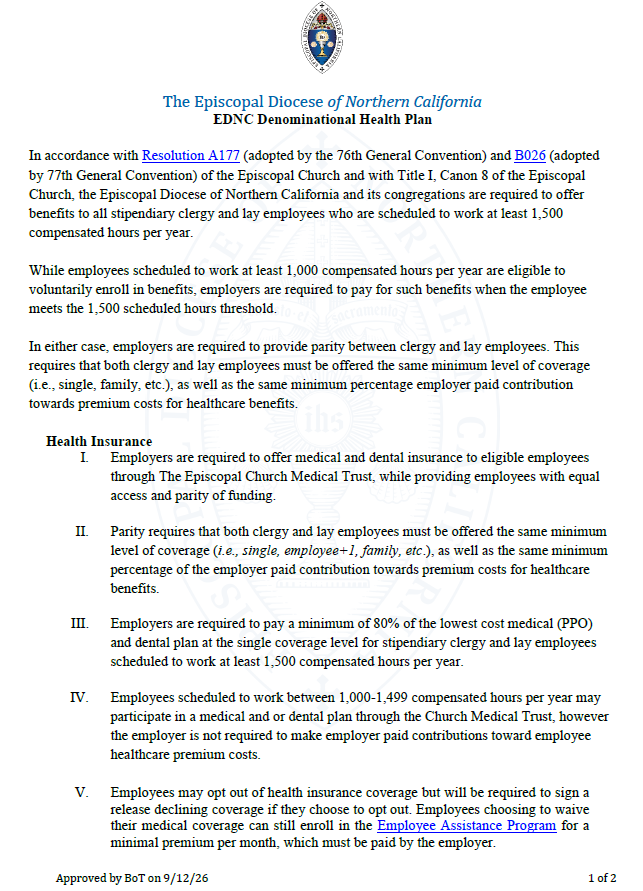
Enrollment Eligibility
An employee is eligible to enroll in benefits if the employee is normally scheduled to work 1,000 or more compensated hours per plan year, regardless of whether they are an exempt or non-exempt employee. However, employers are not required to cover the cost of these benefits unless the employee is scheduled to work 1,500 or more compensated hours per plan year.

2026 Deductible Increases for Anthem and Cigna CDHP-15
Anthem and Cigna CDHP-15
For 2026, the minimum amounts that must be imposed as deductibles under an HDHP are $1,700 for self-only coverage and $3,400 for family coverage. The amounts for 2025 were $1,650 and $3,300, respectively. Effective January 1, 2026, the Medical Trust’s Anthem and Cigna CDHP-15 network deductibles will be $1,700 for self-only coverage and $3,400 for family coverage. The out-of-network deductibles will be $3,400 for self-only coverage and $6,800 for family coverage.
2026 Deductible Increases for Kaiser CDHP-20
For 2026, the minimum amounts that must be imposed as deductibles under an HDHP are $1,700 for self-only coverage and $3,400 for family coverage. The amounts for 2025 were $1,650 and $3,300, respectively. Effective January 1, 2026, the Medical Trust’s Anthem, Cigna, and Kaiser CDHP-20 network deductibles will be $3,400 for self-only coverage and $6,800 for family coverage. The out-of-network deductibles will be $3,400 for self-only coverage and $6,800 for family coverage.

The Episcopal Diocese of Northern California offers
the following benefits to eligible employees:
- Medical (Anthem, Cigna, Kaiser), Dental, Vision, Prescription (Rx), Behavioral Health, Telehealth Services
- Employee Assistance Program (EAP)
- Pension
- Life Insurance
- Disability (Short-term & Long-term)
- Travel Assistance
Read more about EDNC’s Denominational Health Plan (DHP) here!

February 5, 2025:
It has come to our attention that some Anthem & Cigna members may be experiencing issues with the transition to the new Quantum Health ID cards.
As a reminder, effective January 1, 2025, Quantum Health is our NEW healthcare navigator, and the main point of contact for Anthem and Cigna members. Quantum Health is NOT your new insurance provider. Your insurance provider remains Anthem or Cigna. Quantum Health was contracted by the Church Medical Trust as a liaison between members and their insurance provider to help manage, facilitate, and centralize member services.
All Anthem and Cigna members should receive a new Quantum Health ID card with NEW Participant ID and Group ID numbers by February 10, 2025. If you do not receive one by that date, please reach out to Quantum Health and let them know (1-866-871-0629). You can also print your ID card directly from your Quantum Health portal at myquantumcare.org.
Members MUST share this card/new ID numbers with doctors, pharmacists, and other providers—except dentists—as the current Anthem and Cigna ID cards will no longer be valid. (Members will continue to use the Delta Dental ID with dentists, and EyeMed ID for vision specialists.)
NOTE: Some members who have received their new cards and shared it with their providers are being told by their providers that they are showing up as “inactive” in their system. We have contacted Quantum Health and inquired about this issue. They have discovered that two things are happening with the majority of the calls they are receiving:
1) Providers offices are making typos when entering the new ID numbers, so please be sure to request that they repeat the numbers back to you to ensure they have not missed a digit or added anything extra.
2) Providers offices are only updating the Participant ID and not the Group ID number. BOTH numbers have changed and must be updated in their system.
If neither of these options resolve your issue, please call Quantum Health at (1-866-871-0629), and they can assist you further.
If you have any important procedures or surgeries coming up, we urge you to confirm this information with your providers well in advance to avoid any delays.

Its more crucial now than ever before to protect yourself and your loved ones against illnesses like the flu. The flu vaccine is one of the easiest ways to do so. It will also help to reduce the strain on healthcare systems responding to the COVID-19 pandemic.
Members of the Medical Trust can receive flu shots at any pharmacy that participates in the Express Scripts network at no cost to the member. Be sure to call in advance to schedule an appointment and to check on flu vaccine availability. And don’t forget your Express Scripts member ID card; you will be required to present it at the time of service.
To find a pharmacy participating in the Express Scripts network, log in at express-scripts.com and click “Prescriptions”, then “Find a Pharmacy”.
Plan Rates & Plan Comparisons
PLAN RATES:
PLAN COMPARISON CHARTS:
All the Medical Trust plans provide care through a network of doctors, dentists, hospitals, pharmacies, laboratories, and other providers. However, the different types of plans offer a range of options regarding the availability and cost of care in and out of network. The plan descriptions below can help you understand the features for each plan type. We offer the following types of medical plans:1
- Exclusive Provider Organization (EPO) Plan
- Preferred Provider Organization (PPO) Plan
- Consumer-Directed Health Plan/Health Savings Account (CDHP/HSA)
- Medicare Secondary Payer (MSP) Small Employer Exception (SEE) Plan
*All plans include preventive care, prescription coverage, as well as vision and hearing benefits.
EPO (Exclusive Provider Organization) (Kaiser Plans only)
Members enrolled in a Kaiser EPO Plan agree to use only the plan’s network of professionals and facilities, and they are responsible for ensuring that the services and care they receive are covered by the plan. Kaiser EPOs do not cover the cost of services received from out-of-network providers, except in emergency situations.
As the Kaiser plans are built on a managed-care platform, members are required to select a Primary Care Physician (PCP), and, depending on your service area, may need a referral to see a specialist.
PPO (Preferred Provider Organization)
PPO members can receive services from any provider — inside or outside of the plan’s network — without coordinating their care through a primary care physician. However, the plan pays greater benefits for care received from a network provider or facility. PPO members are responsible for ensuring that the services and care they receive are covered by the plan. They are often responsible for submitting their own claims for out-of-network care.
CDHP/HSA (Consumer-Directed Health Plan /Health Savings Account)
A CDHP/HSA member’s coverage consists of two parts:
- A traditional health plan that promotes preventive care and protects members against catastrophic healthcare expenses (Consumer-Directed Health Plan) and
- A tax-advantaged savings/reimbursement account (Health Savings Account) that allows members to take control of their day-to-day healthcare costs.2
With the exception of certain types of preventive care, the benefits from a Consumer-Directed Health Plan begin after the member meets the annual deductible.3 Contributions to a Health Savings Account help members build savings for current and future medical expenses that fall within the deductible of the health plan. A list of qualified medical expenses that may be paid with funds held in the HSAs can be found at the IRS website.
How the CDHP works:
The Consumer-Directed Health Plan works much like a PPO. Members can receive services from any provider, and they do not have to coordinate their care through a PCP. While the CDHP covers services in and out-of-network (like the PPO), the CDHP provides very strong financial incentives for members to use network providers.4 Under these plans, certain preventive care services are not subject to the deductible and require no cost share if provided by network providers.
How the HSA works:
The Health Savings Account is funded by the employee and/or employer, with a “tax-favored” status. Members can open an HSA only if they are enrolled in a qualified High Deductible Health Plan. When they incur medical expenses, they can choose to pay with either HSA funds or out-of-pocket. If HSA funds are not used, the balance continues to grow with tax-free earnings and is available for future medical expenses.
Funds deposited in an HSA belong to the member until they are spent. Unused dollars may earn interest tax-free, with certain restrictions. If members change employers or retire, they can take their HSA with them. Withdrawals from an HSA are tax-free, as long as they are used to pay for qualified medical expenses. Distributions from an HSA that are not used for qualified medical expenses will be assessed a penalty of 20 percent. For tax reporting, it is important for members to retain records of these expenses.
eLearning course:
Health Savings Accounts and High Deductible Health Plans
Download:
CDHP/HSA Fact Sheet for Members
Investing Your HSA Brochure
Medicare Secondary Payer (MSP) Small Employer Exception (SEE) Plan
The Medical Trust provides the option for eligible employers to apply for the Medicare Secondary Payer (MSP) Small Employer Exception (SEE). If an employer applies for and is approved for the plan, eligible employees and their spouses can choose to participate in the SEE Plan.
In most cases, Medicare is the secondary payer of healthcare claims for active employees covered under Medicare Part A, and the Medical Trust plan is the first, or primary, payer. Medicare allows for an exception to the secondary payer rule for small employers called the Small Employer Exception (SEE). Participation in SEE is voluntary for eligible employers and their employees. It is anticipated that out-of-pocket costs will be lower for plan participants and that employers will save significantly in the cost of health benefits.
These plans are noted with MSP in the plan name.
Qualifying for SEE:
In order to be eligible to participate, employees and/or spouses must be:
- 65 years or older
- Enrolled in Medicare Part A
- Enrolled in a Medical Trust SEE plan
- Work for an employer with fewer than 20 employees (The exception must be applied for and approved before the SEE Plan can be implemented.)
What costs are covered?
Under the exception, Medicare will become the primary payer of claims covered under Medicare Part A. These include hospitalization expenses, including inpatient care in hospitals, skilled nursing facilities, hospices and home healthcare settings. The Medical Trust plan will be the secondary payer. For other coverage, such as doctor visits, outpatient procedures and prescription drug coverage, the Medical Trust plan will be the primary payer. However, if an employee or eligible spouse elects to enroll in Medicare Part B coverage, Medicare will become the primary payer of Part B claims and the Medical Trust plan will be the secondary payer.
Webinar On-Demand:
MSP SEE Plan Member Education 
Download:
Medicare Secondary Payer SEE Member Fact Sheet
SEE Certification Eligibility Form
1Every group does not offer every plan. Please check with your group administrator for the plans available to you.
2In general, members and/or their spouses are not eligible for the CDHP/HSA option if they have any other health coverage that would apply to services covered by the CDHP/HSA, such as coverage through a spouse’s employer. Participation in a flexible spending account (FSA) may also limit a member’s ability to obtain coverage under the CDHP/HSA option.
3The CDHP deductible is a combination of medical and pharmacy deductible requirements. Therefore, to begin receiving benefits from the CDHP medical and prescription drug plans, members must meet one combined deductible.
4 The Kaiser CDHP-20/HSA is built on a managed care platform, and therefore requires the selection of a Primary Care Physician, requires a referral to see a specialist, and does not have out-of-network benefits.
2026 Anthem Plan Information
Active Plans (Under 65)
- Anthem BCBS CDHP – 15/HSA
- Anthem BCBS BlueCard PPO 70
- Anthem BCBS BlueCard PPO 80
- Anthem BCBS BlueCard PPO 90
- Anthem BCBS BlueCard PPO 100
Active MSP Plans (65+)
- Anthem BCBS BlueCard MSP PPO 70
- Anthem BCBS BlueCard MSP PPO 80
- Anthem BCBS BlueCard MSP PPO 90
- Anthem BCBS BlueCard MSP PPO 100
Not sure whether to select a CDHP or PPO plan?
Click here to download a worksheet where you can compare out-of-pocket costs!
Contact Quantum Health for questions about Anthem BCBS:
quantum-health.com
Phone: (866)-871-0629
*All plans include preventive care, prescription coverage, as well as vision and hearing benefits.
2026 Cigna Plan Information
Active Plans (Under 65)
Active MSP Plans (65+)
Not sure whether to select a CDHP or PPO plan?
Click here to download a worksheet where you can compare out-of-pocket costs!
Contact Quantum Health for questions about Cigna:
quantum-health.com
Phone: (866)-871-0629
*All plans include preventive care, prescription coverage, as well as vision and hearing benefits.
2026 Kaiser Plan Information
Active Plans (Under 65)
Not sure whether to select a CDHP or PPO plan?
Click here to download a worksheet where you can compare out-of-pocket costs!
Contact Kaiser Permanente:
Visit Kaiser Permanente to find Member Services phone numbers for your region.
*All plans include preventive care, prescription coverage, as well as vision and hearing benefits.
2026 Delta Dental Plan Information